
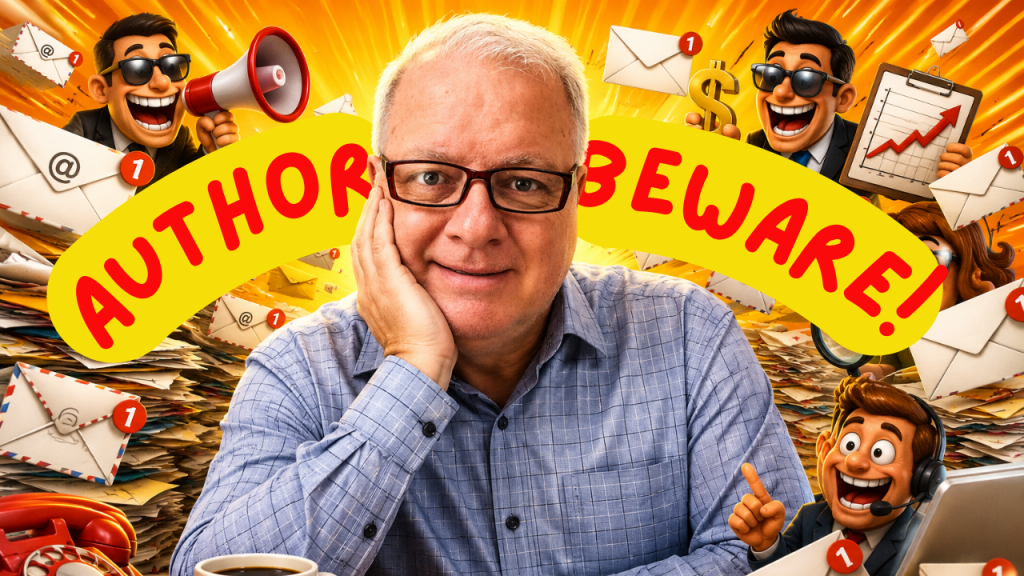
There is something strangely therapeutic about writing. You sit down with a coffee, a memory, an opinion or perhaps a little unresolved trauma from 1987, and suddenly the words begin pouring onto the page. Sometimes writing is healing. Sometimes it is emotional. Sometimes it opens doors in your mind you forgot even existed. It can stir up memories, regrets, joys and frustrations you thought had long since retired to the attic of your brain.
Then you publish a book and discover an entirely different emotional experience.
The vultures arrive.
As a newer independent author, I had this wonderfully naïve idea that the publishing world would mostly consist of readers, reviewers and perhaps the occasional polite literary discussion. Instead, what I discovered was an entire cottage industry of people who appear to spend every waking hour hunting authors like me across the internet.
On average, I now receive about five emails a day from “publishing experts,” “branding strategists,” “SEO specialists,” “Amazon growth consultants,” “book visibility experts,” “genre analysts,” “reader engagement professionals” and several people who apparently possess secret knowledge unavailable to the rest of humanity.
Five a day.
At this point, I hear from these people more often than some of my actual relatives.
The routine is almost always the same.
First comes the warm introduction:
“Dear Doug, I was deeply moved by your work.”
Interesting, considering my book launched approximately twelve minutes ago.
Then:
“You have tremendous potential.”
Apparently, I am one keyword away from becoming the Canadian Stephen King.
Soon after, they begin asking thoughtful questions about my motivation, my writing process and my personal journey as an author. They seem fascinated by my creativity, my inspiration and my authentic voice. For a brief moment, you begin to think:
“Well, this is nice. Perhaps someone genuinely appreciates my work.”
Then comes the kill shot.
For only $1,497 US dollars, they can fix the catastrophic SEO disaster that I didn’t know I had.
They know exactly why my book is not reaching millions. My cover is wrong. My subtitle is weak. My metadata is underperforming. My Amazon categories are flawed. My keywords are ineffective. My online presence lacks optimization. My font choice may be causing emotional distress to potential buyers in Nebraska.
Thankfully, they alone possess the solution.
These people speak with the confidence of NASA engineers preparing for a moon landing.
“We have proprietary systems.”
“We understand reader psychology.”
“We know exactly what your genre audience responds to.”
“We have proven strategies.”
Oddly enough, these proven strategies always seem to involve me sending them money.
Lots of it.
What fascinates me most is the sheer size of this industry. There appears to be an endless supply of people trying to carve out a living from aspiring authors. Somewhere out there, there must be giant office towers filled with self-appointed “book marketing specialists” roaming the hallways carrying mood boards and SEO charts while hunting vulnerable memoir writers from Canada.
And if you politely decline?
That is when the guilt arrives.
“Oh. I understand. That’s disappointing.”
“We truly believed in your project.”
“We were excited to help you succeed.”
Suddenly you feel like you have personally cancelled Christmas.
The emotional manipulation is almost impressive in a strange sort of way.
Look, I understand that there are legitimate editors, designers and marketers out there. Some people absolutely provide real value and honest professional services. But mixed into that world is an army of opportunists who have realized something important:
Writers are emotionally invested in their work.
Books are personal. They are not just products. They are pieces of people. That makes authors vulnerable, especially newer ones still learning the business.
And that vulnerability has become an economy all its own.
The truth is, most independent authors are not looking for miracles. They are simply hoping someone might read what they spent months or years creating. That hope becomes fertile ground for every self-declared “publishing guru” with a Gmail account and a Canva subscription.
So now, whenever I receive one of these emails promising to unlock my “untapped bestseller potential,” I smile politely and move on.
Because if my writing career does collapse completely, at least I know one thing with absolute certainty:
There will still be five people tomorrow morning offering to save it.


Leave a Reply