
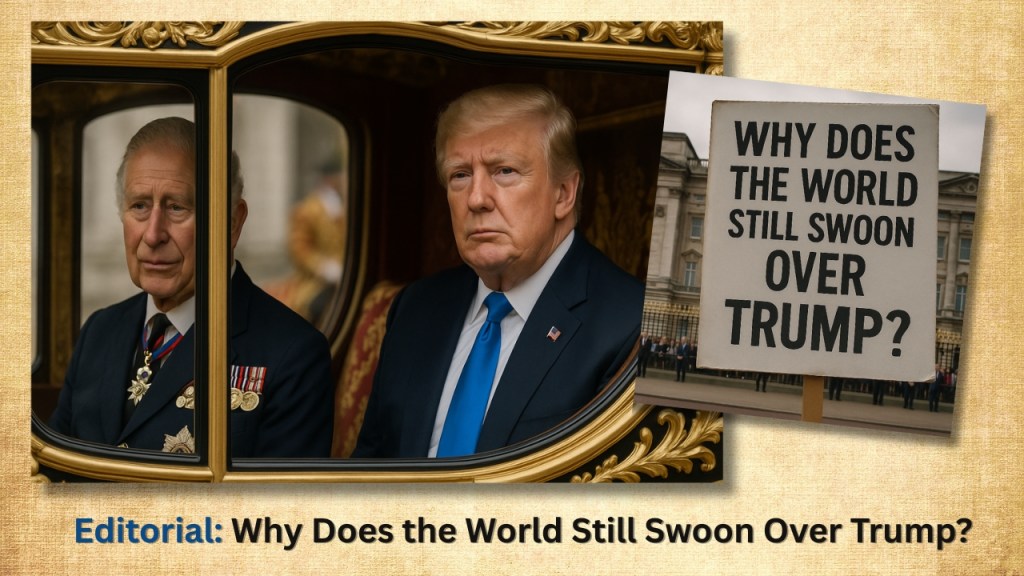
Donald Trump has once again strutted onto the world stage, this time in the United Kingdom, and the headlines followed like moths to a flame. Crowds gathered, cameras flashed, and dignitaries extended the sort of courtesy usually reserved for figures who bring unity and progress, not division and despair. It leaves me wondering, as a Canadian looking across the Atlantic and south of the border, how the world still swoons over a man who has done more to humiliate and divide nations than almost anyone in modern memory. The world once bent a knee to men like Hitler and Mussolini, both of whom dragged societies into chaos. To witness a similar indulgence of Trump, cloaked in royal treatment, should trouble us all.
I cannot understand why people who should know better still fawn over his every move. Leaders shake his hand, royal palaces open their gates, and global media outlets spill ink and airtime in endless coverage. It is almost as though the very institutions he mocks, undermines, and destabilizes are the ones that keep him relevant. This is not just a U.S. domestic drama anymore. Every time Trump steps into international view, he brings the whole world along for his circus, whether we want to buy tickets or not.
Canada’s Dilemma in the Shadow of Trump
As a Canadian, I feel the consequences closer than most. We have been backed into corners before, tied economically to the United States, but rarely has the pressure felt so personal and so transactional. Now the message comes in the form of fighter jets. Buy the American F-whatever number they are currently touting, or face consequences. Never mind that Sweden’s Saab jets might be a more practical or affordable choice for our needs. Trump’s ideology, if you can even call it that, has turned military procurement into a loyalty test. Do what he says or brace for retaliation.
This is not partnership, it is bullying. It is the sort of economic hostage-taking that makes smaller allies like Canada rethink our entire foreign policy. We used to speak of the American Dream as a kind of shared aspiration, a belief in democracy and opportunity. Now that dream looks more like a fevered nightmare where threats replace cooperation.
Why Does the World Tolerate Him?
What troubles me most is the global tolerance for this behavior. Why are leaders lining up to give him audiences and official dinners? Why is the red carpet rolled out as if he were a monarch or a liberator rather than a man who thrives on chaos? Nations that once prided themselves on sovereignty now bend the knee to a personality cult that is distinctly American but exported with frightening efficiency.
Imagine if the world simply ignored him. Imagine if the cameras turned away, the microphones stayed off, and the motorcades were left to circle empty streets. Imagine if leaders closed their doors rather than their eyes. The influence of Trump thrives on attention. Deprive him of it, and what remains? A loud man shouting at walls rather than dictating the future of alliances.
What If the World Said “No”?
Let us go further. Suppose the world stopped playing along entirely. Suppose nations closed their borders to American trade, cut off financial ties, and suspended diplomatic relations. Suppose NATO expelled the United States, the World Bank and the United Nations sidelined Washington, and international organizations declared that America was no longer a partner until it returned to sanity. What then?
The immediate reaction would be shock. The United States, still the largest economy on earth, would lash out with tariffs, sanctions, and probably lawsuits. The global markets would panic. Oil prices would swing, stock exchanges would tumble, and currencies would wobble. No one should underestimate the turbulence of suddenly unplugging the world’s largest plug from the socket.
Yet chaos might not last forever. Nations have learned to trade around others before. Russia has faced sanctions for years and still finds ways to sell oil and gas. Iran continues to exist despite decades of isolation. Cuba has survived an embargo longer than most of us have been alive. If smaller nations can adapt, could not the rest of the world survive without Washington? The short-term pain might yield long-term independence.
Pros of Cutting Ties with America
One advantage of such a bold step would be clarity. The world would no longer have to dance around Trump’s every whim. Countries could forge new alliances based on shared values rather than fear of American retaliation. Europe might finally unite militarily, with or without NATO. Canada could deepen its partnerships with Europe, Asia, and yes, Sweden, without Washington breathing down our necks.
Another benefit would be the moral high ground. By refusing to enable an authoritarian-leaning leader, the world could demonstrate that democracy is not for sale, not even to the wealthiest nation. It would send a signal to future generations that bullies are not rewarded with royal treatment.
Finally, cutting ties could hasten the end of Trumpism itself. If Americans suddenly faced global isolation, if their travel, trade, and prestige evaporated, perhaps the electorate would finally reckon with what Trump has cost them. Nothing motivates change like pain, and nothing speaks louder than empty shelves, lost markets, and canceled vacations abroad.
Cons of Such a Strategy
Of course, the costs would be enormous. The global economy is not a game of Monopoly where you can simply flip the board and start fresh. Cutting ties with the United States would devastate industries worldwide. Canada’s economy, tied as tightly as any to the U.S., would feel the hit most immediately. Millions of jobs depend on cross-border trade. From cars to lumber to wheat, our livelihood is intertwined with theirs. Closing that door would not just sting, it would bleed us dry in the short term.
There is also the risk of war, literal war. A cornered United States, stripped of influence and furious at betrayal, might lash out militarily. Trump has shown a willingness to brandish threats, and his followers cheer at the sound of strongman rhetoric. To isolate America completely might be to invite conflict.
Diplomatically, the world might fracture rather than unite. Some nations would quietly side with Washington, unwilling to give up lucrative markets. Others would hedge, creating a patchwork of allegiances that looks less like solidarity and more like chaos. The dream of a unified global stand could dissolve into another round of divided blocs.
The Canadian Question
So where does this leave Canada? Stuck, as always, between principle and survival. We want to assert independence, to say no when the bully pushes us into the corner. At the same time, we cannot cut off our own oxygen. Our trade, our security, and our daily life are tied to the neighbor we sometimes wish we could ignore.
Perhaps the Canadian solution is not all or nothing. Perhaps we do not slam the door but rather step back from it. We can invest more in European alliances, deepen ties with Asia, and yes, support defense options that are not stamped with “Made in America.” We can chip away at dependence without pretending we can sever it overnight. The more diverse our partnerships, the less threatening Trump’s ultimatums become.
Why the World Still Plays Along
So why does the world continue to swoon? The answer may be fear, habit, and the simple lure of power. Leaders know that defying Trump risks his wrath, and his wrath can be costly. Nations accustomed to American dominance have trouble imagining a world without it. The global press, meanwhile, cannot resist a story that sells, and Trump sells like no one else. He is both villain and spectacle, a walking headline machine who knows how to keep himself in focus.
It may also be that some secretly admire his raw approach. In a world where politics often looks cautious and scripted, Trump’s bluntness feels refreshing to some, even if it comes wrapped in cruelty and lies. There is a disturbing attraction to strongmen, a tendency for crowds to rally behind certainty even when it leads them off a cliff.
The Case for Saying No
Still, I believe the world should test what happens if we stop playing along. Even if not every nation joins, even if Canada alone decides that Saab makes more sense than Lockheed, every refusal chips at the foundation of Trump’s power. Every moment we say “no” instead of “yes” weakens the illusion that he holds the world in his palm.
The case for saying no is not just economic or political. It is moral. It is about whether we will let a man who thrives on division continue to dictate the terms of global order. Do we want future generations to remember this era as the time when nations bent to the will of one authoritarian personality, or as the moment when they finally stood up and said enough?
What We Have to Lose
The truth is, we have a lot to lose. Economically, diplomatically, militarily, the costs would be staggering. Yet we also have much to lose by continuing down this path. If Trump remains unchallenged, the global order risks collapse anyway. Alliances fray, trust dissolves, and international cooperation becomes a relic of the past. What kind of world will our children inherit if we keep enabling him?
It is not enough to sigh at the headlines, to shake our heads at the circus. Action matters. Whether that action is closing borders, cutting trade, or simply refusing to buy the latest overpriced fighter jet, every stand matters.
Conclusion: Stop Him in His Tracks
The world does not need to kneel at Trump’s feet. We do not need to hand him microphones or parades. We can stop him in his tracks by choosing different paths, by building alliances that do not revolve around Washington, and by recognizing that bullies lose power when people stop listening.
The MAGA base is not changing. They are locked in their worldview. The rest of us cannot wait for them to wake up. We must decide whether to keep indulging the madness or to finally say no. Canada has a role to play, as do Britain, Europe, Asia, and every nation tired of the drama.
I am not naive. Closing borders, severing ties, and isolating America would come at a steep price. Yet the price of continuing to enable Trump may be even steeper. The question is whether we have the courage to pay one now to avoid paying far more later.
History teaches us that strongmen fall, but only when others stop carrying them on their shoulders. The world has the power to disavow Trump’s existence in the halls of diplomacy. It only takes the will to act. The longer we hesitate, the deeper the damage.
So I ask again. Why do we still swoon? Why do we treat him like royalty when he treats the world like subjects? The time has come to put the pageantry aside and face reality. If we want to protect democracy, unity, and dignity, we must stop Trump before he drags us all further down.
 dougrogers.ca
Leave a comment