
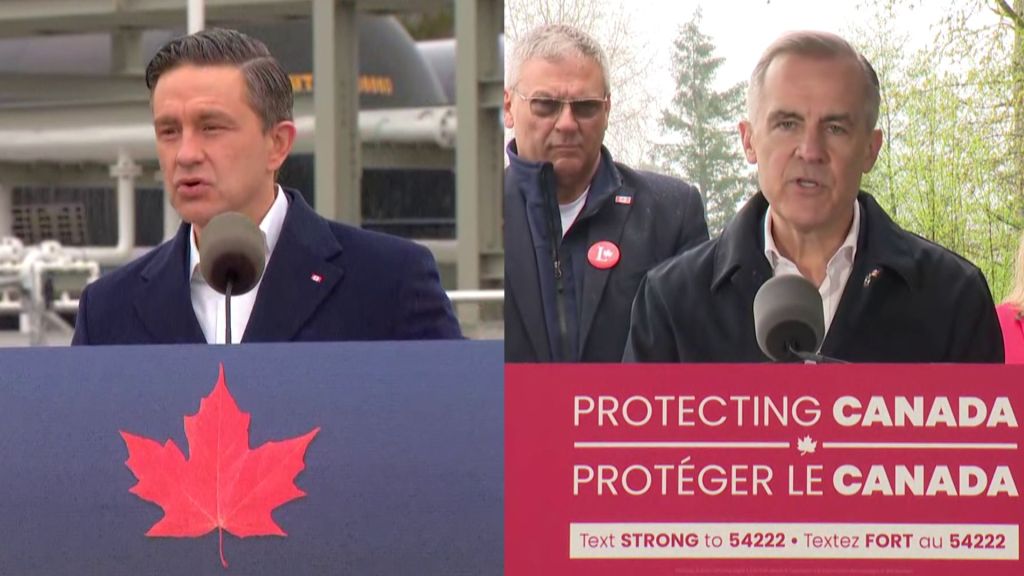
Politics appears to be more and more like theatre. Every detail is deliberate. From a leader’s tie colour to the backdrop behind their podium, nothing is accidental. That’s why the sudden trend of extra-large podium signage—most notably used by Conservative Leader Pierre Poilievre and Liberal-hopeful Mark Carney—deserves closer scrutiny. These oversized visual shields don’t just carry slogans; they carry meaning. And increasingly, they look like a metaphor for the politics both men are practicing: big, bold messaging that hides more than it reveals.
Let’s begin with the basics. These podium signs are now nearly waist-to-shoulder height, often covering much of the speaker’s torso, and sometimes even rising to the base of their chin. At a glance, they’re simply campaign tools—designed for crisp branding, clear messaging, and maximum impact in photographs and video clips. But when the sign is nearly as tall as the man behind it, it’s no longer just branding. It’s a wall.
What are they hiding behind that wall?
For Poilievre, it’s the sharp-edged populism that he carefully softens in public appearances. His slogans—“Axe the Tax,” “Bring it Home,”—are short, punchy, and aggressively vague. The massive sign does two things: it repeats the message for media-friendly framing, and it physically shields him from unscripted vulnerability. You’re not watching a man speak; you’re watching a billboard that happens to move its mouth. It’s image control at its most literal.
Mark Carney’s use of similarly large signage is no less calculated. As a former central banker stepping into the messy world of partisan politics, Carney’s brand is still being shaped. The oversized sign lets him project confidence while reducing the risk of distraction or personal scrutiny. Like Poilievre, he can stand behind a fortress of text and avoid the human element that sometimes undermines tightly crafted narratives. Behind the sign, he can be anyone—or more conveniently, anything the campaign wants him to be.
There’s also a not-so-subtle psychological element at play. In a world dominated by visual media, these podiums are designed for clips, not crowds. The larger the sign, the more dominant it becomes in the frame. It dwarfs dissent. It monopolizes attention. It makes the speaker seem like the embodiment of the message, not just its messenger. But therein lies the problem: when the message becomes everything, what’s left of the person delivering it?
These signs aren’t just about slogans. They’re about control. They signal a retreat from spontaneity, from nuance, from real-time accountability. When politicians hide behind extra-large signs, it’s because they don’t want to be seen saying the message—they want the message to say everything for them. And that should concern us.
Because leadership isn’t just about slogans or optics. It’s about standing for something—and standing without a wall in front of you.
If the leaders of today want our trust, they might consider stepping out from behind their signage and speaking to us, not just at us. After all, we elect people—not posters.
 dougrogers.ca
Leave a comment