
What’s the Difference?
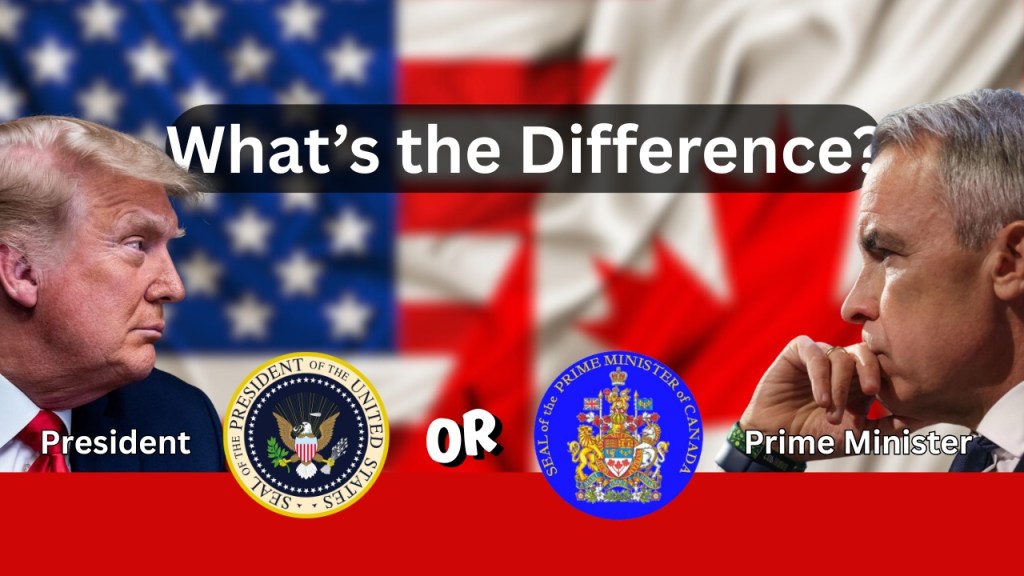
Canada and the United States offer a fascinating contrast between their political systems—Canada with a parliamentary system led by a Prime Minister, and the U.S. with a presidential system headed by a President.
In Canada, the Prime Minister is the leader of the political party that has the most seats in the House of Commons. However, their position isn’t guaranteed—they must maintain the confidence of Parliament. If a vote of non-confidence takes place and passes, the government could collapse, which would then trigger an election. Unlike in the U.S., there’s no fixed term for a Prime Minister, though elections are required at least every four years, or sooner if needed. Another key feature of Canada’s system is the Governor General, who represents the British monarch as a ceremonial head of state. This highlights Canada’s status as a constitutional monarchy. In this setup, the Prime Minister and their cabinet are also members of Parliament, meaning that the executive and legislative branches are intertwined. Interestingly, someone can become Prime Minister even if they haven’t been elected to Parliament yet, though they typically must secure a seat through a by-election soon after. A quirk of the system, but entirely legal!
In contrast, the United States operates under a presidential system where the President is both the head of state and the head of government. This means they handle both ceremonial duties and executive functions. Presidents are elected independently of Congress, serve fixed four-year terms, and don’t rely on maintaining the confidence of Congress to stay in office. They are also limited to serving two terms, or a maximum of eight years. Unlike Canada, the U.S. doesn’t have a separate ceremonial head of state, so the President fulfills both roles. A distinctive feature of the U.S. system is the strict separation of powers between the executive, legislative, and judicial branches, ensuring a system of checks and balances. At least that is how it is supposed to work. The current Trump administration is challenging those checks and balances, thus threatening a change in the U.S. system of government.
Ultimately, Canada blends powers, while the U.S. keeps them separate, leading to very different political dynamics between the two countries.
 dougrogers.ca
Leave a comment